Stein am Rhein & Rhine Falls: The Complete Combined Day Trip
Europe's largest waterfall and Switzerland's best-preserved medieval town sit 22 km apart, both under an hour from Zurich. Here is the hour-by-hour plan, every 2026 fare, and an honest comparison of doing it yourself versus booking the coach.
Both in One Day, Comfortably
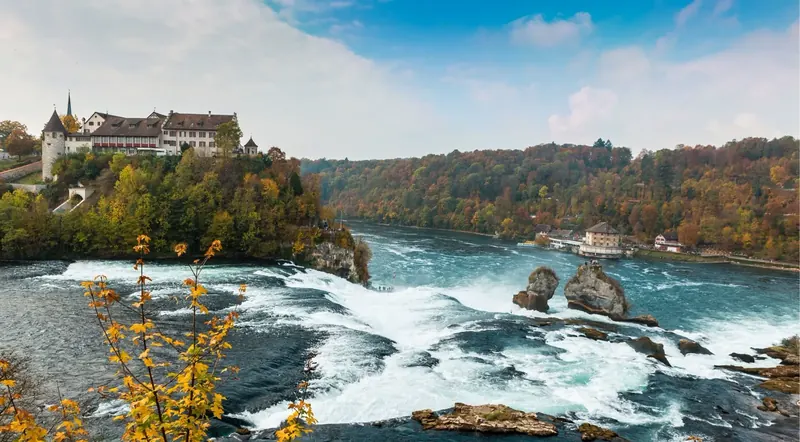
You can absolutely see both Rhine Falls and Stein am Rhein in one day from Zurich. The Rhine Falls sits between Neuhausen am Rheinfall and Schloss Laufen, about 50 km north of Zurich, and Stein am Rhein lies roughly 22 km upriver where Lake Constance's Untersee empties into the Rhine. They are only about 22 km apart and both under an hour from the city, so a DIY train day trip works beautifully and costs roughly CHF 55–75 in train fares. The most efficient plan is the falls first thing in the morning — a direct ~50-minute train to Schloss Laufen am Rheinfall — then a ~25-minute train via Schaffhausen to Stein am Rhein for the afternoon. Prices and boat timetables both move; confirm the day's sailings before you build your plan around them.
From April to October you can swap one train leg for the scenic URh Rhine boat. And if you would rather not plan at all, a guided coach tour from Zurich covers both in about 5 hours from around USD 107 (roughly CHF 95–105, boat ride extra) — easier, but the DIY train trip is cheaper, more flexible, and lets you linger.
Good to know
- Rhine Falls first (morning light, before the coaches), town second
- Connecting train: Schloss Laufen → Schaffhausen → Stein am Rhein, ~30–50 min
- The URh boat is a scenic experience, not a shortcut — 2 hours upstream
- Falls basin boats are not covered by any Swiss rail pass
Budget, per adult
- DIY train day trip: ~CHF 55–75 transport, ~CHF 70–90 all-in
- With a Half Fare Card: roughly half that
- With a Swiss Travel Pass: trains and the URh boat free
- Guided coach tour: ~CHF 95–105 (from USD 107)
Why Stein am Rhein Is Worth the Train
A medieval core of 5.76 km², the first Wakker Prize in Switzerland, and facades that owners are legally obliged to maintain.
Stein am Rhein is a small town in the canton of Schaffhausen, in Switzerland's far northeast right on the German border, at the point where the Untersee (Lower Lake Constance) narrows back into the High Rhine. According to the official municipal site, steinamrhein.ch, "Per 31. Dezember 2024 zählt die Stadt Stein am Rhein insgesamt 3'790 Einwohnerinnen und Einwohner" — 3,790 residents as of 31 December 2024, up 220 on the previous year. Its medieval core covers just 5.76 km² and retains its original medieval street plan, its city gates — the Untertor and Obertor both survive — and town walls now built into houses.
History
Around 1007, Holy Roman Emperor Henry II moved St George's Abbey (Kloster St. Georgen) from the Hohentwiel near Singen down to what was then a small fishing village, to strengthen his grip on this strategic crossing of major road and river routes. He gave the abbots extensive rights over the town and its trade; the town grew rich and, in the 15th century, was briefly granted reichsfrei (imperial free) status. The abbey rebuilt itself in late Gothic style in the 15th century. Under the Reformation the abbey was secularised around 1524–1525 and its assets passed to Zürich.
Why it's celebrated
In 1972 Stein am Rhein received the inaugural Wakker Prize from the Swiss Heritage Society. The prize — worth CHF 20,000, and first awarded in 1972 thanks to a bequest from the Geneva businessman Henri-Louis Wakker — recognised the town's exemplary conservation. The citation stated: "Probably nowhere else in Switzerland and only in very few places in Europe can you find so many outstanding individual buildings in such a small space." Six buildings in the old town plus the Rathaus are listed Swiss heritage sites of national significance, and owners of the frescoed houses must maintain the paintings in their original condition at their own expense.
Other Experiences You Might Enjoy
This corner of Switzerland rewards a second day. Popular pairings include the Rhine Falls at Neuhausen am Rheinfall and Schloss Laufen, the Rhyfall Mändli boat to the central rock, medieval Schaffhausen with its Munot fortress, the URh Rhine cruise toward Lake Constance and Konstanz, and day trips from Zurich to the Black Forest. The handpicked experiences below update automatically based on the destinations covered on this page.
The Painted Facades: Rathausplatz and Beyond
The square first, then the abbey, then — if your legs are willing — the castle on the hill.
The heart of the old town is Rathausplatz (Town Hall Square), often called the country's most beautiful town square, and lined with half-timbered and stone houses covered in vivid frescoes and fitted with ornate carved oriel (bay) windows. The Rathaus itself was built 1539–1542 and renovated to its current appearance around 1900.
The key painted houses
- Haus zum Weissen Adler (White Eagle, Oberstadt 1) — the town's crown jewel. First mentioned in 1418, its facade frescoes are attributed to the Schaffhausen/Stein artist Thomas Schmid and painted around 1520–1525, making them the oldest surviving Renaissance facade paintings in Switzerland. They depict medieval and humanist motifs including the Bocca della Verità (the mouth of truth, a test of fidelity) and scenes drawn from Boccaccio's Decameron and the Gesta Romanorum. The building belongs to the Zunft zum Kleeblatt and is being restored.
- Haus zur Sonne and its neighbours on the square carry the famous "Geh mir aus der Sonne!" motif — Diogenes and Alexander the Great. Several of these facades were repainted around 1900.
- Weinstube zum Rothen Ochsen (Rathausplatz 9) — the town's oldest tavern, first mentioned in 1446, with both facade and interior paintings. The building was fundamentally rebuilt in 1615 and is a national heritage listed building.
Other highlights
- Kloster St. Georgen / Museum Kloster Sankt Georgen (Fischmarkt 3) — one of the best-preserved late-medieval Benedictine monastery complexes north of the Alps, right on the riverbank next to the Rhine bridge. The museum tour leads through the former monks' quarters, the abbots' houses, the cloister and the celebrated banquet hall, built in 1515 under the last abbot, David von Winkelsheim, with important early-16th-century murals by Thomas Schmid and Ambrosius Holbein.
- Burg Hohenklingen — a 13th-century hilltop castle roughly 200 m above the town, reached by about a one-hour walk up through residential streets and vineyards. The grounds are free to enter, the views over the town, the Rhine and toward Lake Constance are panoramic, and it houses a well-regarded restaurant.
- The Rhine bridge and riverfront promenade, Museum Lindwurm (19th-century bourgeois life), and the Krippenwelt nativity museum.
Time to budget: the old town core takes 1.5–2 hours to stroll and photograph; add about an hour for the abbey museum, and 2+ hours round trip if you hike up to Hohenklingen. A relaxed half-day of 3–4 hours covers it comfortably.
Kloster St. Georgen museum — 2026 practicalities
- Open: 3 April to 1 November 2026, Tuesday–Sunday, 12:00 noon to 17:00, closed Mondays. Some third-party listings still show older 10:00–17:00 hours; the official abbey site lists 12:00–17:00 for the current season.
- Admission: Adults CHF 5; groups of 10+ CHF 4 each; children and young people under 16 free. Free with ICOM, the Swiss Museum Pass and certain other cards.
Every Way Between Rhine Falls and Stein am Rhein
Four options, one of which we would actively talk you out of.
The two sit about 22 km apart — roughly 13–14 miles by road. Your options:
- Train (fastest, year-round). No single direct line runs frequently; the normal route is Schloss Laufen am Rheinfall → Schaffhausen → Stein am Rhein, changing at Schaffhausen. The Schaffhausen → Stein am Rhein leg takes about 25 minutes, operated by Thurbo. Total with the connection is roughly 30–50 minutes depending on the wait, and trains run frequently through the day.
- Seasonal Rhine boat (scenic). The URh scheduled boat links Schaffhausen and Stein am Rhein. It does not run all the way to the falls — you take a short bus or train between Schaffhausen station and the falls, and the boat dock in Schaffhausen (Schifflände) is about a 20–30 minute walk, or a short bus ride, from Schaffhausen station.
- Driving. About 23–24 minutes for the ~22 km. Park outside the old town walls in Stein am Rhein, which is pedestrianised.
- Direct bus. There isn't a practical one. Bus routing via Schaffhausen and Ramsen takes about 1h40 and is not recommended.
The URh Rhine Boat, in 2026 Detail
One of Europe's prettiest river cruises — and genuinely slow, which is the whole point.
- Operator: Schweizerische Schifffahrtsgesellschaft Untersee und Rhein (URh), Freier Platz 8, Schaffhausen — sailing this route since 1865.
- 2026 season: 3 April to 18 October 2026, on the Schaffhausen–Stein am Rhein–Konstanz/Kreuzlingen line. Frequency is highest in the main summer season, roughly early July to mid-September; shoulder-season sailings are more limited and some run only on Sundays and holidays.
- Journey time: about 2 hours upstream (Schaffhausen → Stein am Rhein; for example dep. 09:10, arr. 11:15) and about 1h15 downstream (Stein am Rhein → Schaffhausen; for example dep. 11:30, arr. 12:45).
- 2026 one-way adult fare: CHF 30.20 full price (EUR 32.90); half fare about CHF 15.10. A URh Day Card is CHF 49.50, or CHF 31 with a Half Fare Card. A return is simply 2× one-way — there is no round-trip discount. Tickets are sold on board and online. Note that the Schaffhausen → Öhningen fare of CHF 36.40, one stop further, is sometimes misquoted for this route; the correct Schaffhausen ↔ Stein am Rhein single is CHF 30.20.
- Passes: the Swiss Travel Pass gives free travel on this URh route; the Swiss Half Fare Card / Halbtax gives 50% off; the GA Travelcard is also valid. The Rhine Falls basin boats — Rhyfall Mändli — are a separate operator and are not covered by these passes.
- 2026 service note: URh warns of a service interruption between Stein am Rhein and Diessenhofen from Saturday 27 June 2026 due to low water. On the Kreuzlingen/Konstanz–Stein am Rhein stretch the summer timetable runs as normal, and Schaffhausen–Diessenhofen round trips continue. Check urh.ch on the day, as low water could affect the Schaffhausen ↔ Stein am Rhein leg.
The Realistic Combined Itinerary from Zurich
Zurich HB to Schloss Laufen am Rheinfall is a direct train of about 50 minutes, running roughly hourly from early morning — and there are also frequent connections via Schaffhausen or Neuhausen.
Suggested full-day DIY itinerary (any season)
- ~08:15 — Depart Zurich HB → Schloss Laufen am Rheinfall (direct, ~50 min).
- ~09:05–11:15 — Rhine Falls: walk down to the viewing platforms on the Schloss Laufen (southern) side, take the panorama lift, cross to Schlössli Wörth, and from April to October take a Rhyfall Mändli boat to the central rock. Budget about 2 hours.
- ~11:20 — Train Schloss Laufen → Schaffhausen (~5–10 min), change for Stein am Rhein (~25 min).
- ~12:15 — Arrive Stein am Rhein; about a 10-minute walk to the old town. Lunch on Rathausplatz.
- ~13:00–16:30 — Explore the frescoed old town, St George's Abbey museum and the riverfront, and optionally hike up to Hohenklingen.
- ~16:40 or later — Train Stein am Rhein → Zurich HB (about 1h to 1h20, usually changing at Winterthur or Schaffhausen), arriving in Zurich in the early evening.
Scenic summer variant (April–October)
Do the falls in the morning, take the train to Schaffhausen, then take the URh boat Schaffhausen → Stein am Rhein (~2 hours), arriving early afternoon; explore the town and return to Zurich by train. Or reverse it: go straight to Stein am Rhein first, take the faster downstream boat back to Schaffhausen (~1h15), then visit the falls, then travel home. Doing the town first and the boat downstream saves about 45 minutes of boat time.
Rhine Falls Entry and Boats — 2026 Costs
Free on one bank, CHF 5 on the other, and the boats priced separately from everything else.
- Northern bank (Neuhausen/Schlössli Wörth): free to walk the promenade.
- Southern bank (Schloss Laufen): entry CHF 5 adults, CHF 3 children aged 6–15, including the viewing platforms, the panorama lift and the Historama exhibition.
- Basin boat trips (Rhyfall Mändli): short round trips from about CHF 10; the "Rock Experience" to the central rock is priced from about CHF 22.50. The season runs roughly late March/April to October, and the 30-minute falls tour is bookable ahead as the Rhine Falls boat tour from Neuhausen (from $13, ★ 4.8 from 3,000+ reviews). Not covered by Swiss rail passes.
- On the guided coach tours, the optional Rhine Falls boat ride is typically CHF 12 per adult / CHF 8 per child, payable on the spot.
Scale of the falls. Per Wikipedia's Rhine Falls entry, average summer flow is 600 m³/s (600,000 litres per second) and winter about 250 m³/s; "the highest flow ever measured was 1,250 cubic metres per second in 1965, and the lowest, 95 cubic metres per second in 1921." The falls are 150 m wide and about 23 m high. For context on crowds: "Following a time of mass tourism after World War II, with up to 3 million visitors annually, the number of tourists declined subsequently, with 1.3 million tourists counted in 2014."
Guided Tour Options from Zurich (2026)
Several operators bundle both attractions into one half-day trip. One of them dominates the reviews.
From Zurich: Stein am Rhein and Rhine Falls
Best of Switzerland Tours' half-day coach, sold via GetYourGuide, Viator and Civitatis, and running about 5 hours from Zurich Sihlquai Bus Station near Zurich HB. A multilingual guide, an air-conditioned coach, entry to both the Rhine Falls and Laufen Castle, and a guided walk through Stein am Rhein are all included, with the drive itself running through farming villages and vineyards. The optional falls boat ride is CHF 12 for adults and CHF 8 for children, paid on the spot; the boat is not suitable for guests with reduced mobility or for strollers.
Check availabilityPrivate tours. Premium private round trips — a luxury vehicle, roughly two hours at each stop — and combined private trips that add, say, Titisee and the Black Forest, are available through GetYourGuide and Viator at considerably higher prices, often several hundred francs per group. We have deliberately not linked any of them: every private Rhine Falls and Stein am Rhein listing we checked currently carries no reviews at all, and we will not point you at an unrated product at that price.
What's included, generally. Transport, guiding, and falls and castle entry. Lunch is at your own expense, and the boat ride is usually optional and extra.
Planning several Swiss trips around this one? A Swiss Travel Pass (from $316, ★ 4.8 from 2,103 reviews) makes the trains and the URh boat free, though the falls basin boats still cost extra. Ratings and review counts checked against the live GetYourGuide listings on 12 September 2026; prices are the "from" figures GetYourGuide advertises and move with demand.
Practical Tips
When to come, how long to allow, what the cobblestones will do to the wrong shoes, and where to eat.
- Best time of year. May and June are ideal — the falls run at their fullest from Alpine snowmelt, the boats are running, and it is before the peak school-holiday crowds. April to October is the sweet spot overall, because that is when the seasonal boats operate. The falls and Stein am Rhein are both open and attractive year-round, but neither the URh Rhine boat nor the falls basin boats run in winter.
- Half day or full day? Both attractions are individually doable as half-days. Combined, it is a comfortable full day; a rushed half-day is only realistic if you skip the boat and don't linger.
- Walkability and accessibility. Both old towns are compact and very walkable — wear comfortable shoes for the cobblestones. The Rhine Falls involves stairs and steep paths; the Belvedere platform and the northern bank are the most accessible parts, with lift access on the Schloss Laufen side, but the site overall is challenging for wheelchairs and strollers.
- Lunch in Stein am Rhein. The Rathausplatz terraces are the classic choice. Weinstube zum Rothen Ochsen (Rathausplatz 9) is the historic favourite, a Swiss and European wine tavern with 15th-century origins, and Restaurant Adler is on the square too. For a splurge with a view, Burg Hohenklingen serves refined French-influenced Swiss cuisine at the castle — reservations advised. Other options include Restaurant Ilge, Rheinfels and the riverside terraces.
- Book ahead for the falls basin boat in peak summer, and reserve Hohenklingen if you want to dine there.
DIY by Train vs the Guided Coach
Approximate full-fare second-class figures — the comparison that decides how most people travel.
| Leg | Approx. cost per adult |
|---|---|
| Zurich HB → Schloss Laufen am Rheinfall | ~CHF 22–28 |
| Schloss Laufen → Schaffhausen → Stein am Rhein | ~CHF 10–13 |
| Stein am Rhein → Zurich HB | ~CHF 30–33 |
| Train subtotal | roughly CHF 55–75 |
| + Rhine Falls south-bank entry, and an optional basin boat from ~CHF 10 | realistic all-in ~CHF 70–90 without lunch |
| Guided coach tour (transport, guiding, falls and castle entry) | ~CHF 95–105 (from USD 107); boat +CHF 12, lunch extra |
With a Swiss Half Fare Card (CHF 150 for one month), halve the train and boat portion. With a Swiss Travel Pass (from CHF 254 for 3 days, 2nd class, in 2026), the trains and the URh boat are free — the falls basin boats still cost extra. On the scenic variant, replace one train leg with the URh boat at CHF 30.20 one-way full fare, or free with the Swiss Travel Pass.
Verdict. For independent travellers, the DIY train trip is cheaper and far more flexible, and it is genuinely easy on Switzerland's rail network. The guided tour is worth it mainly if you want zero logistics, guided commentary and a fixed five-hour window — but you will see less of Stein am Rhein and you can't linger.
How We'd Plan It
Five recommendations, including the benchmarks that would change the plan.
- Default plan, for most readers: go DIY by train. Take an early direct train around 08:00–08:30 from Zurich HB to Schloss Laufen am Rheinfall, do the falls first (about 2 hours, before coach groups peak mid-morning), then train via Schaffhausen to Stein am Rhein for lunch and an afternoon in the old town. Return to Zurich by early evening.
- If you're travelling April–October and you love scenery, build the day around the URh boat. The best sequence is Stein am Rhein first, then the faster ~1h15 downstream boat to Schaffhausen, then the falls, then home — that maximises the boat experience without losing two hours upstream.
- If you want zero planning, book the Best of Switzerland Tours half-day (from USD 107, about CHF 95–105) and add the optional boat. Accept that you will have limited free time in Stein am Rhein.
- Buy the right pass. If this is a standalone day, individual tickets — or a Half Fare Card if you have other trips planned — are fine. If you're taking several Swiss trips, a Swiss Travel Pass makes the trains and the URh boat free and the falls entry easier to justify.
- Benchmarks that change the plan. Visiting outside April–October? Drop the boat entirely and do it purely by train. Is the 27 June 2026 low-water interruption in effect? Use the train for the Stein am Rhein–Schaffhausen leg. Only have a half day? Pick one attraction — the falls if you want spectacle, Stein am Rhein if you want atmosphere.
Five Things That Could Change These Numbers
- Fares fluctuate. Swiss point-to-point rail fares vary with SBB Supersaver availability and how early you book; the CHF figures above are typical 2nd-class full fares, not guarantees. Confirm on the SBB app on the day.
- The boat schedule is weather- and water-dependent. URh sailings can be reduced, rerouted or cancelled in fog, storm, or high or low water; the flagged low-water interruption from 27 June 2026 specifically affects the Stein am Rhein–Diessenhofen section.
- Museum hours differ across sources. The abbey museum's official 2026 season page lists Tue–Sun 12:00–17:00 to 1 November 2026, while some third-party listings still show 10:00–17:00. Go by the official site.
- Tour prices are dynamic and quoted in USD on booking platforms; the CHF equivalents above are approximate and change with exchange rates and demand.
- Rhine Falls boat operators are separate from the URh line and are not covered by Swiss rail passes — a common and expensive point of confusion.
Stein am Rhein & Rhine Falls: Common Questions
Order, connections, the boat, the costs and the pass trap — answered up front.
Can you visit Rhine Falls and Stein am Rhein in one day?
Yes, comfortably. The two sit only about 22 km apart and both are under an hour from Zurich, so a DIY train day trip works well and costs roughly CHF 55 to 75 in train fares. The efficient order is Rhine Falls first thing in the morning — a direct train of about 50 minutes to Schloss Laufen am Rheinfall — then a roughly 25-minute train via Schaffhausen to Stein am Rhein for lunch and the afternoon.
Which should you visit first, Rhine Falls or Stein am Rhein?
Rhine Falls first. You get the morning light and you arrive before the coach groups peak mid-morning. Stein am Rhein then works as a relaxed afternoon of lunch on Rathausplatz and a stroll through the old town. The one exception is the scenic summer variant: if you want the URh Rhine boat, do the town first and take the faster downstream sailing back to Schaffhausen, which saves about 45 minutes of boat time.
How do you get from Rhine Falls to Stein am Rhein?
By train, changing at Schaffhausen: Schloss Laufen am Rheinfall to Schaffhausen takes about 5 to 10 minutes, then Schaffhausen to Stein am Rhein about 25 minutes on Thurbo, so roughly 30 to 50 minutes in total depending on the connection. Driving takes about 23 minutes. From April to October you can instead take the scenic URh boat from Schaffhausen, though it is slow. There is no practical direct bus — routing via Schaffhausen and Ramsen takes about 1 hour 40 minutes.
Is the Rhine boat between Schaffhausen and Stein am Rhein worth it?
It is one of Europe's prettiest river cruises, but treat it as an experience to build the day around rather than a way of getting there. The URh boat takes about 2 hours upstream from Schaffhausen to Stein am Rhein and about 1 hour 15 minutes downstream. The 2026 season runs 3 April to 18 October, a one-way adult fare is CHF 30.20, and it is free with the Swiss Travel Pass and half price with the Half Fare Card.
How much does the Rhine Falls and Stein am Rhein day trip cost?
Doing it yourself by train costs roughly CHF 55 to 75 per adult in full-fare second-class rail, or about CHF 70 to 90 all-in once you add the CHF 5 south-bank entry at Schloss Laufen and an optional basin boat from about CHF 10. A guided coach tour from Zurich runs about CHF 95 to 105, from USD 107, including transport, guiding and falls and castle entry, with the boat ride a further CHF 12 and lunch extra.
Why is Stein am Rhein famous?
For its painted facades and its intact medieval core. In 1972 it received the very first Wakker Prize from the Swiss Heritage Society, whose citation read: "Probably nowhere else in Switzerland and only in very few places in Europe can you find so many outstanding individual buildings in such a small space." Six buildings in the old town plus the Rathaus are listed Swiss heritage sites of national significance, and the frescoes on Haus zum Weissen Adler, painted around 1520 to 1525, are the oldest surviving Renaissance facade paintings in Switzerland.
What are the Kloster St. Georgen museum's 2026 opening hours?
The abbey museum is open 3 April to 1 November 2026, Tuesday to Sunday, 12:00 noon to 17:00, and closed on Mondays. Admission is CHF 5 for adults, CHF 4 each for groups of 10 or more, and free for children and young people under 16, as well as with ICOM, the Swiss Museum Pass and certain other cards. Some third-party listings still show older 10:00 to 17:00 hours — go by the official site.
When is the best time of year for this day trip?
May and June are ideal: the falls run at their fullest from Alpine snowmelt, the boats are running, and it is before the peak school-holiday crowds. April to October is the broader sweet spot because the seasonal boats operate. Both the falls and Stein am Rhein are open and attractive year-round, but neither the URh Rhine boat nor the falls basin boats run in winter.
Do Swiss rail passes cover the Rhine Falls boats?
No, and this is a common point of confusion. The Rhine Falls basin boats are run by Rhyfall Mändli, a separate operator, and are not covered by the Swiss Travel Pass, the Half Fare Card or the GA. The URh line between Schaffhausen and Stein am Rhein is different: the Swiss Travel Pass gives free travel on it, the Half Fare Card gives 50% off, and the GA Travelcard is valid.