Panoramic Trains
- Glacier Express — CHF 54 reservation
- Bernina Express panoramic car — CHF 40–44
- Gotthard Panorama Express — CHF 24
- GoldenPass Express Prestige — ~CHF 20
- Jungfraujoch (May 1–Oct 31 2026) — CHF 10
Zurich is the single best base in Switzerland for scenic rail. The Glacier Express, Bernina Express and Gotthard Panorama all connect from here in 1–2 hours — and the everyday trains to Rhine Falls, Lucerne and Chur are spectacular in their own right. Here's what to book, what to skip and what every visitor gets wrong about Swiss rail passes.
Most Swiss trains need no reservation at all. This is the single most important thing to understand. On all SBB InterCity, InterRegio and regional services you simply buy a ticket and sit in any free seat — trains cannot sell out. Reservations are compulsory only on the four or five tourist panoramic trains (Glacier Express, Bernina Express panoramic car, Gotthard Panorama Express, GoldenPass Prestige).
None of the famous named trains start in Zurich, but all connect easily. The Glacier Express (Zermatt–St. Moritz) and Bernina Express (Chur–Tirano) require a normal — and very scenic — IC train from Zurich to Chur or Brig first. The Gotthard Panorama Express and GoldenPass connect via Lucerne, just 45 minutes from Zurich.
For 1–2 day trips, skip the Swiss Travel Pass. The Rhine Falls costs about CHF 26 return, Lucerne about CHF 27 — far cheaper than a 3-day pass starting at CHF 254. The pass pays off only when you're making three or more intercity journeys per day across multiple days.
None of these trains start in Zurich — but all are easy to join after a short IC connection.
What Switzerland Tourism calls "the world's slowest express train" takes travellers across the Alps in roughly 8 hours, passing through 91 tunnels and over 291 bridges, cresting the Oberalp Pass at 2,033 m. Panoramic windows, a dining car and arguably the most dramatic Alpine scenery in Europe.
From Zurich: Not direct. Take a regular IC to Chur (~1h15) and join at Chur, or travel to Brig (~2h) for the Zermatt end. The Glacier Express cannot be done as a day trip from Zurich — you need to overnight at one end (Zermatt or St. Moritz).
2026 prices: The base fare is covered by Swiss Travel Pass or Half Fare Card; the mandatory seat reservation is CHF 54 in 2026 (up from CHF 49). Excellence Class surcharge: CHF 540 one-way. 2026 note: Excellence Class is reported fully booked for all of 2026. Maintenance shutdown runs 11 Oct–4 Dec 2026 with no trains at all. Summer seats sell out weeks after reservations open (93 days / ~3 months ahead) — book as early as possible.
144 km over 196 bridges and through 55 tunnels, cresting Ospizio Bernina at 2,253 m and crossing the UNESCO Albula/Bernina lines — including the Landwasser Viaduct and the extraordinary Brusio circular viaduct. Runs year-round. The most realistically doable panoramic train as a Zurich day trip.
From Zurich: Take a regular IC Zurich→Chur (~1h15, itself very scenic along Lake Zurich and the Walensee — sit on the left outbound) and change to the Bernina Express at Chur. Early trains from Zurich (from ~06:38) allow a full-day loop back via rail.
2026 prices: Swiss Travel Pass covers the base fare; mandatory seat reservation is CHF 40 (low season: Dec 14 2025–May 1 2026 and Oct 26–Dec 12 2026) or CHF 44 (high season: May 2–Oct 25 2026) for the full Chur–Tirano route; short St. Moritz–Tirano section is CHF 32 year-round. Money-saver: the identical route is served by ordinary red RhB regional trains that need no reservation (optional CHF 5 seat) — same views, no panoramic roof.
~5.5 hours combining a lake steamer Lucerne–Flüelen and a 1st-class panoramic train Flüelen–Lugano over the historic 1882 Gotthard mountain line with its spiral tunnels, ending in Italian-speaking Ticino. Seasonal: runs daily 18 April–18 October 2026 only.
From Zurich: Reach Lucerne in ~45 min by regular IC. The train ends in Lugano — you'd overnight in Ticino or return by the fast base-tunnel train.
2026 prices: Swiss Travel Pass covers boat and train; mandatory reservation is CHF 24. The train is 1st class only, so 2nd-class pass holders pay a class upgrade too.
The full GoldenPass runs ~5.5 hours: Luzern–Interlaken Express (~2h over the Brünig Pass) plus the GoldenPass Express Interlaken–Montreux (~3h15) — a world-first gauge-changing train since December 2022 that eliminates the old change at Zweisimmen. Runs year-round. Fully covered by Swiss Travel Pass. Reservations optional in 1st/2nd class, compulsory in Prestige (18 elevated, rotating leather seats facing the direction of travel).
From Zurich: Reach Lucerne in ~45 min and board the Luzern–Interlaken Express. The full route ends in Montreux — overnight there or return by fast SBB.
A scenic, hourly ~2h15 InterRegio run by Südostbahn (SOB) bypassing Zurich — crossing the Rapperswil lake dam, the Rothenthurm moorland and the 99 m Sitter Viaduct (Switzerland's highest railway viaduct). Modern copper-red Traverso trains and gentle Pre-Alpine scenery. No reservation needed. Free with Swiss Travel Pass, 50% with Half Fare Card. Easily joined from Rapperswil or St. Gallen.
Two of Switzerland's most famous mountain railways — both require a transfer far from Zurich. Gornergrat: cogwheel railway from Zermatt to 3,131 m with Matterhorn views; Swiss Travel Pass and Half Fare Card give 50% off. Jungfraujoch: Europe's highest railway station at 3,454 m; from Zurich it's ~3h33 minimum each way (via Interlaken), so it's a long but technically doable day trip. 2026 adult return fares roughly CHF 100.60–234.80 depending on route/season; Swiss Travel Pass gives 25% off, Half Fare Card 50% off. A CHF 10 seat reservation is mandatory 1 May–31 Oct 2026.
Switzerland's train network connects effortlessly with some of the region's best experiences. Visitors who take the scenic rail to Rhine Falls often combine it with a Rhine Falls boat tour from Neuhausen or a medieval stroll through Stein am Rhein. The Bernina Express route over the Alps pairs naturally with a stop in Chur, Switzerland's oldest town. Closer to Zurich, a Lucerne day trip with a Lake Lucerne cruise and an excursion to Mount Rigi or Mount Pilatus round out a week of Switzerland's best scenery. The handpicked experiences below update automatically based on the destinations covered on this page.
All the following run on ordinary SBB trains — no reservation required, trains cannot sell out, go whenever you like. Approximate 2026 full-fare 2nd-class one-way prices.
| Destination | Travel time from Zürich HB | Approx. 2026 one-way fare | Best for |
|---|---|---|---|
| Rhine Falls (Schloss Laufen / Neuhausen) | ~50 min, direct every ~30 min | ~CHF 23 (return ~CHF 26) | Half-day; Europe's largest waterfall |
| Lucerne | ~41–52 min direct | ~CHF 27 | Full day; Chapel Bridge, Lake Lucerne, Pilatus/Rigi gateway |
| Interlaken Ost | ~2 hours via Bern or Thun | ~CHF 75 | Full day; Jungfrau region gateway |
| Chur | ~1h14–1h30 direct | ~CHF 41 | Full day; Switzerland's oldest town, Bernina/Glacier Express gateway |
| Appenzell | ~1h45 via St. Gallen or Gossau | ~CHF 40 | Full day; painted houses, Alpstein/Säntis massif |
| St. Gallen | ~1 hour direct | ~CHF 30 | Half/full day; UNESCO Abbey Library, Voralpen-Express terminus |
The Zurich → Chur route deserves a special mention: it runs along Lake Zurich and through the dramatic Walensee gorge — sit on the left outbound — and is one of the most scenic regular IC journeys in Switzerland. It also doubles as your access route to both the Bernina Express and the Glacier Express, making it useful regardless of which panoramic train you board.
Switzerland Tourism states plainly: "In Switzerland, most trains do not require a seat reservation… no surcharges are payable on national InterCity and InterRegio trains." You can optionally reserve a seat on some long-distance trains for CHF 5, but locals rarely bother.
Reservation is compulsory only on the panoramic tourist trains: Glacier Express, Bernina Express (panoramic cars only), Gotthard Panorama Express, GoldenPass Express Prestige class, plus certain Postbus routes. These are marked "Z" in the SBB timetable; reservable-but-optional trains are marked "R."
What this means in practice: You can decide at breakfast to catch the next train to Rhine Falls, Lucerne or Chur, walk up to the ticket machine, buy a ticket and board. No planning required. The only trips that demand advance planning are the named panoramic trains — and for the Glacier Express in summer, you genuinely need to book the reservation 2–3 months ahead because they sell out.
The wrong pass is one of the most common — and most expensive — mistakes visitors make.
2026 Swiss Travel Pass prices (adult 2nd class, consecutive): 3 days CHF 254 · 4 days CHF 309 · 6 days CHF 399 · 8 days CHF 439 · 15 days CHF 499. 1st class is ~60% more. The Flex variant (non-consecutive days within a month) costs ~15% more. Prices rose about 5% from January 2026. Youth (16–24) ~30% off; children 6–15 travel free with a parent's pass via the free Swiss Family Card.
2026 Swiss Half Fare Card: CHF 150 for one month — 50% off trains, buses, boats, most mountain railways and panoramic-train base fares.
Do not buy the Swiss Travel Pass. For one or two day trips (Rhine Falls ~CHF 26 return, Lucerne ~CHF 54 return), point-to-point tickets or Supersaver advance fares are far cheaper than a CHF 254 pass. The break-even for a 3-day pass requires roughly three major intercity journeys plus city transport per day.
The Half Fare Card at CHF 150 usually wins when you're adding pricey mountain excursions (Jungfraujoch, Pilatus, Titlis), because it gives 50% off those lifts versus only 25% from the Swiss Travel Pass. If you'll do several mountain trips, the Half Fare Card almost always pays off more quickly.
The Swiss Travel Pass shines when you move cities almost every day, ride multiple panoramic trains (base fares covered — you pay only reservations), want ticketless convenience and free entry to 500+ museums. For 8+ active travel days it is typically the best-value option. The pass never covers panoramic-train reservation fees.
~50 minutes by direct S-Bahn, Europe's largest waterfall by volume, free to view from the north bank — the highest wow-per-hour trip from Zurich.
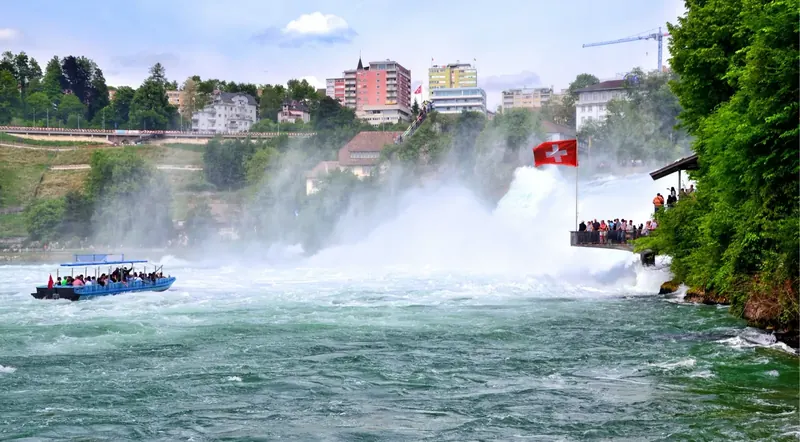
Rhine Falls (Rheinfall) is Switzerland Tourism's textbook example of what's possible from Zurich by rail: over a width of 150 metres, several hundred cubic metres of water thunder 23 metres into the depths every second. Direct S-Bahn services reach Schloss Laufen am Rheinfall on the south bank (right beside the castle and the best close-up platforms) and Neuhausen Rheinfall on the north bank in about 50 minutes, running roughly every half hour. A return fare runs from about CHF 26.
Viewing the falls is free from the north bank at Schlössli Wörth (open 24/7). The south bank at Schloss Laufen costs just CHF 5 for adults (CHF 3 for children 6–15) and gets you onto the Belvedere, Känzeli and Fischetz platforms cantilevered over the water. The standout optional experience is the Yellow Line Rock Experience boat (from CHF 22.50), which lands on the Rheinfallfelsen limestone spire in the middle of the falls, April–October only.
Prefer not to juggle trains, tickets and boat queues? A guided half-day coach tour from Zurich includes Schloss Laufen entry and a live multilingual guide — and gets you back to Zurich in time for a full afternoon of city sightseeing. For the full breakdown of both banks, boats and trains, see our complete Rhine Falls from Zurich guide.
Glacier Express reservations open 93 days out and sell out within weeks for summer — book 2–3 months ahead. Bernina Express panoramic reservations can be made up to 365 days ahead; book several months out for summer travel. Gotthard Panorama Express and GoldenPass are easier — a few weeks ahead is usually fine in the shoulder season. Regular trains (Rhine Falls, Lucerne, Chur) need no advance booking at all.
Booking directly with operators (glacierexpress.ch, rhb.ch, sbb.ch) is cheapest and in CHF. Resellers like GetYourGuide, Trainline, Omio and Rail Europe bundle tickets and reservations for convenience, typically 20–35% more in EUR/USD but often with free cancellation. Guided day tours from Zurich for Rhine Falls and Black Forest run around CHF/USD 60–90 with Schloss Laufen entry included.
Late May–early October for green valleys, blue lakes, open mountain trails and long daylight — the widest variety of views. July–August is warmest but busiest and most expensive. September–October is arguably the sweet spot: stable clear skies, golden autumn colour, thinner crowds, hotel rates easing. December–February offers snow-covered drama, especially on the year-round Bernina Express; some seasonal trains (Gotthard Panorama) don't run in winter. Mountain weather is fickle — watch webcams and save a summit like Jungfraujoch or Gornergrat for the clearest-forecast day.
For day trips involving the best day trips from Zurich — including Black Forest, Stein am Rhein and mountain options — see the full comparison guide with 2026 costs and timings.
Most Swiss trains do not need a reservation. All SBB InterCity (IC), InterRegio (IR) and regional services let you simply buy a ticket and sit in any free seat — trains cannot sell out. Reservations are compulsory only on a small number of tourist panoramic trains:
These are marked "Z" in the SBB timetable. For all other trains — including the direct S-Bahn to Rhine Falls and all IC trains to Lucerne, Bern and Chur — no reservation is needed or expected.