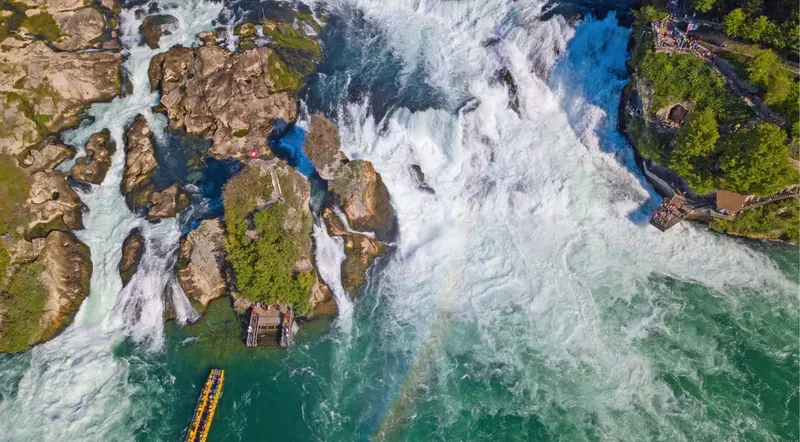
The Rhine Falls sits on the High Rhine near Schaffhausen, between Neuhausen am Rheinfall (north bank, canton Schaffhausen) and Laufen-Uhwiesen/Dachsen (south bank, canton Zurich), about 3 km south of Schaffhausen and close to the German border. When the Rhine has an average flow rate, about 370 m³/s plunge over the rocks; average summer discharge is roughly 600 m³/s and winter about 250 m³/s. The highest flow ever measured was 1,250 m³/s in 1965.
It's the most powerful plain waterfall in Europe — many are taller or wider, but none combine this width with this volume. The falls formed at the end of the last Ice Age, roughly 14,000–17,000 years ago, when the Rhine was pushed south onto a hard Late Jurassic limestone bed. The large rock standing in the middle, the Rheinfallfelsen, is the remnant of the original limestone cliff — approximately 150 million years old.
People have visited since the Middle Ages, and the falls became a fixture of Enlightenment-era "grand tours." Mary Shelley described them in 1840; the poet Eduard Mörike began his 1846 poem "Am Rheinfall" in view of the water. Despite various proposals over the centuries, the falls have never been dammed for hydroelectricity — public pressure has consistently preserved them. Recent estimates put annual visitors at around 2 million.